Quarterly Estimated Tax Tracker
Enter last year's tax and this year's profit. Get the amount for each installment, the next due date, and a running check of paid against required.
| Due | Required | Paid | Status |
|---|
How the number is worked out
Federal only; most states with an income tax have their own estimates. The four payments are treated as equal. This is general information to help you plan, not tax advice. Runs in your browser; nothing is sent or saved.
How to use it
Four dates, one number
-
Start with last year's return
Find the total tax line on last year's Form 1040 and your adjusted gross income. Paying 100% of that tax during this year, or 110% when the AGI was over $150,000, keeps you clear of the underpayment penalty.
-
Add this year's profit
The profit you expect from self-employment or rentals, and the income tax rate you expect to pay on it. The tool adds self-employment tax and shows 90% of the total, the other way to stay clear.
-
Log each payment
Type what you paid for each installment. The table shows which dates are covered and how much is still due for the next one.
Keep it going every month
Small Business Bookkeeping & P&L Spreadsheet
A monthly profit and loss that builds itself from your entries.
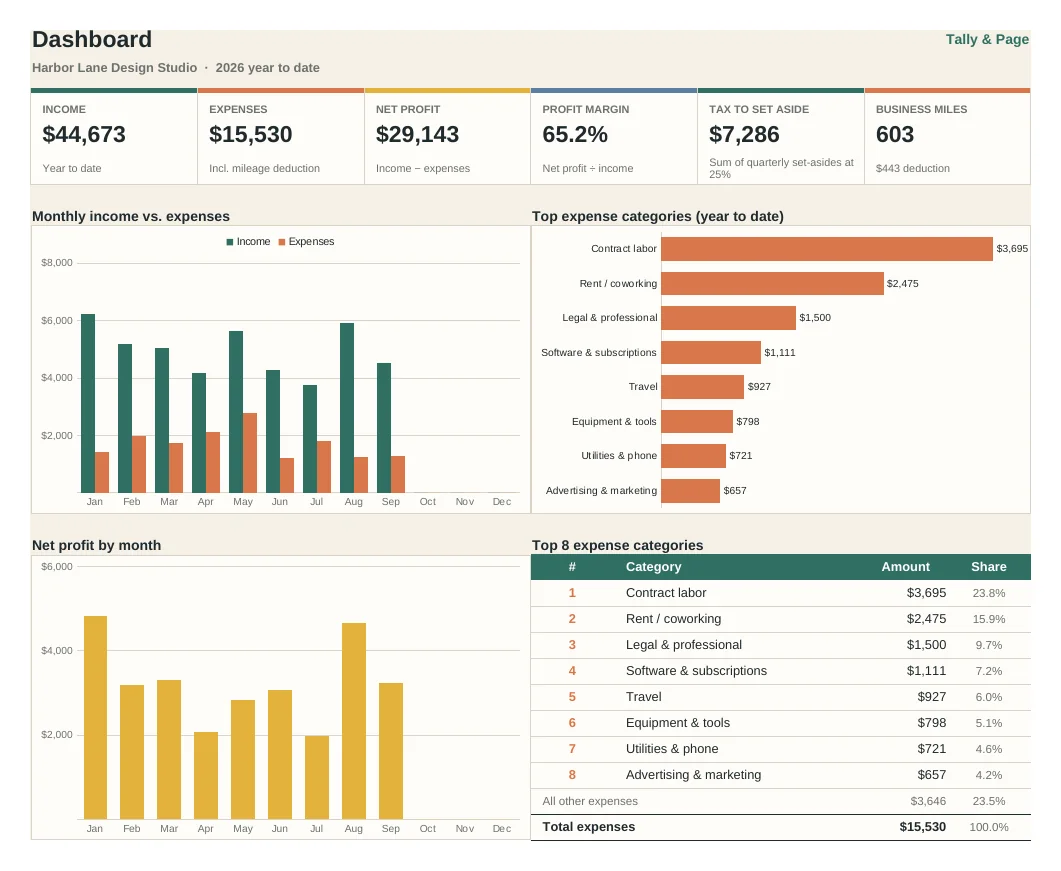
- Profit and loss by month, January to December, with year totals
- 1,000-row transaction log with category and payment-method dropdowns
- 24 ready-made income and expense categories plus 6 of your own
- Quarterly tax set-aside at your percentage, with estimated-payment due dates
- 500-trip mileage log that applies the IRS rate in effect on each trip's date
Get the kit: this spreadsheet and the rest of the Small Business Kit (3 products, one download), for $34.
Or get it in the Money & Business Planning Bundle with the other templates, for $39.
Questions
Good to know
Who has to make estimated payments?
Generally anyone who expects to owe $1,000 or more for the year after withholding and credits: the self-employed, landlords, investors, and people with a side income beside a job.
Why are the dates not three months apart?
The IRS periods are uneven: January to March, April and May, June to August, and September to December. Payments are due April 15, June 15, September 15 and January 15, moved to the next business day when one falls on a weekend or holiday.
What income tax rate should I enter?
A workable figure is last year's total income tax divided by last year's taxable income, or the bracket your top dollars fall in. It is your number to set. The safe harbor based on last year's tax does not depend on it.
Does paying the safe-harbor amount mean I owe nothing in April?
No. It means no underpayment penalty. If this year's income is higher, the rest is due when you file.
More free tools
Try another one
More templates